

The White House Claude Mckay
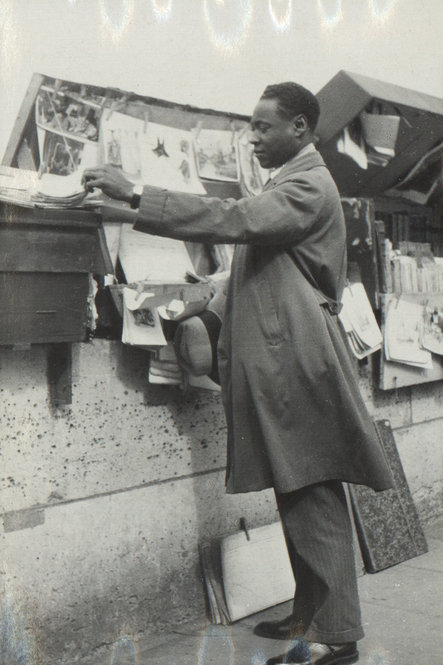
This Feb saw the release of a previously unpublished Claude McKay novel, Affable with Big Teeth (Penguin Classics).
McKay (1889–1948), a major Harlem Renaissance writer, is known for his acknowledged novel Home to Harlem (1928) and poesy, including "If We Must Die."
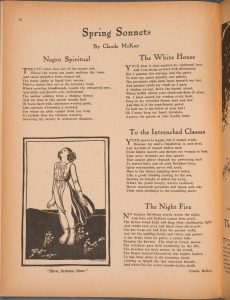
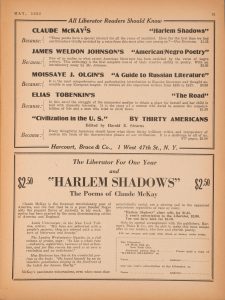
Betwixt 1919 and 1923, much of McKay'south poetry appeared in The Liberator, a socialist mag at which McKay worked with editor Max Eastman. McKay offset published his poem "The White Business firm" in the May 1922 effect along with three other poems. He would afterwards describe "The White House" every bit part of a series of sonnets "expressing my bitterness, detest and love."
In 1925, when scholar Alain Locke invitee-edited a special graphic result of Survey magazine called "Harlem, Mecca of the New Negro," he selected iii of McKay'southward poems for inclusion. "The White House" was amongst them. Locke, however, changed the title from "The White Business firm" to "White Houses." He was afraid that with the original title, the verse form might exist read as an indictment of the White Business firm in Washington, D.C., and would potentially prevent Jamaican-born McKay, who was traveling abroad, from returning to the United States. (Locke'due south fears were not unfounded; the FBI had ordered community agents not to allow McKay into the land ii years before.)
In his 1937 autobiography, A Long Way From Habitation, McKay described his "amazement and chagrin" at Locke's editorial alter. He had asked Locke to remove the verse form rather than include information technology with a championship that "inverse the whole symbolic intent and meaning of the poem." The title, explained McKay, was a reference to the "vast modern edifice of American Industry from which Negroes were finer barred every bit a group," non a particular habitation. McKay claimed information technology was "ridiculous" to imagine this poem referred to "the official residence of the President of the United States" and that whether he was "permitted to return to America or not, [he] did non want the title changed." Yet Locke moved forwards with publication of the poem equally "White Houses" in the Survey Graphic and retained the "White Houses" championship when he expanded the magazine issue into the landmark album The New Negro (1925).
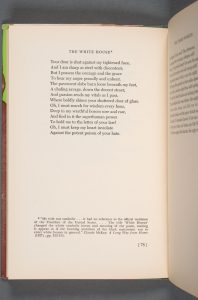
"The White Firm" was not included in McKay's well-received poetry anthology Harlem Shadows (1922). The poem did appear in a 1953 posthumously-published edition of McKay's selected poems. The title, restored to its original form, was followed by an asterisk pointing readers to a footnote with McKay'southward explanation of the verse form'southward championship. Well-nigh 30 years later Locke, and five years after McKay'southward death, the championship "The White House" nonetheless required editorial intervention.
McKay'southward verse form persists as a powerful contemplation of discrimination and exclusion. Information technology concludes:
Oh, I must keep my heart inviolate
Against the potent poison of your hate.
Claude McKay correspondence tin be found in the Ransom Center's William A. Bradley Literary Agency drove. The Center besides holds editions of McKay's Bound in New Hampshire, Harlem Shadows, Home to Harlem, Banjo, A Long Way From Habitation, and Harlem, Negro Urban center.

The White House Claude Mckay,
Source: https://sites.utexas.edu/ransomcentermagazine/2017/02/16/claude-mckay-and-the-white-house/
Posted by: kleinprefor1940.blogspot.com
0 Response to "The White House Claude Mckay"
Post a Comment