

Which Elements Have Similar Properties
It probably seems like all we've been spending a lot of fourth dimension learning near protons… and neutrons… and electrons… and electrons… and more than electrons… and then you lot might be wondering – when practice we really become to written report chemistry? When do we get to study reactions? When exercise we become to written report explosions? When exercise nosotros get to report plastics, and medicines that can exist made by combining different kinds of chemicals? The answer is now. Nosotros're finally ready to discuss the chemical properties of the simplest chemicals out there – nosotros're finally ready to talk over the elements. Remember, you accept learned that in that location were 118 unlike kinds of atoms, and that each was known as an element. And you have learned that atoms of unlike elements have dissimilar numbers of protons. Hydrogen has 1 proton (and i electron if it's neutral), helium has two protons (and two electrons, if information technology'due south neutral), and lithium has 3 protons (and three electrons, if information technology'due south neutral). Finally, y'all have seen examples of the Periodic Table. Scientists use the Periodic Table to summarize information nearly all of the known elements that exist in our earth.
In this lesson, y'all volition learn why the Periodic Table (as shown below) has such an unusual shape.

Now, what's the first thing you lot thought when you saw the Periodic Table? If you're like virtually people, the first thing you idea was probably something similar, "Wow – that's a funny shape! Why is the Periodic Table shaped like that? Why is information technology lower in the middle? Why is it higher on either finish? Why is at that place that odd-looking disconnected piece at the bottom? The Periodic Tabular array doesn't expect like a table at all!" In this chapter, y'all'll begin to run across why the Periodic Tabular array has such a funny shape. It turns out that the shape of the Periodic Table actually helps to tell usa about the chemical properties of the different elements that exist in our earth. In this section, for case, you'll larn that elements in the same column of the Periodic Table have similar chemical backdrop. After nosotros'll accept a await at how elements in the same row are related.
Group 1A (IA) Elements Accept One due south Electron [edit | edit source]
Remember that according to the Aufbau principle electrons are added to low energy orbitals commencement and then, as the low energy orbitals are filled up, electrons go into higher and higher energy orbitals. When one atom reacts with some other cantlet in a chemical reaction, it'south the high-energy electrons that are involved.
Since it's simply the high-energy electrons that participate in a chemical reaction, it'south but the high-energy electrons that we volition concern us when we desire to make up one's mind the chemic properties of a particular element. Just how "loftier" in free energy does an electron demand to be to participate in a chemical reaction? Well, in most chemic reactions, the only electrons involved are the electrons in the highest energy level. In other words, the electrons with the highest value of due north (the principal quantum number), participate in chemical reactions, while the electrons with lower values of n are called "core electrons", are closer to the nucleus and, as a outcome, don't get involved. The electrons with the highest value of n are known as valence electrons. Core electrons are also referred every bit non-valence electrons. Two different elements have like chemic properties when they have the same number of valence electrons in their outermost energy level.
Elements in the same column of the Periodic Table take similar chemical backdrop. And so what does that mean about their valence electrons? You guessed it! Elements in the same column of the Periodic Table accept the aforementioned number of valence electrons – that's why they accept similar chemic properties. Let's see if this is truthful for some of the elements in the first column of the Periodic Table.
Example i – Hydrogen
Write the electron configuration for hydrogen (H).
Solution:
First, you need to observe hydrogen on the Periodic Table. Take a expect at the Periodic Table above. You know that hydrogen is in the kickoff cavalcade, and if yous look carefully, yous'll see that hydrogen also happens to be at the pinnacle of the first column. The Periodic Tabular array tells you that the atomic number for hydrogen is Z = 1, thus hydrogen has one proton. Neutral hydrogen volition also have 1 electron. You need to write the electron configuration for an atom with 1 electron.
Every bit shown in the figure below, the diagonal rule applied to hydrogen (H).

Therefore, nosotros write the electron configuration for H: idue south 1.
Remember, when y'all write electron configurations, the number out in front e'er indicates the master breakthrough number, northward, of a particular orbital, thus 1s 2 has n = 1, while 3s 1 has n = 3. What is the highest principal quantum number that y'all see in hydrogen'south electron configuration? Information technology'due south n = 1, so all electrons with n = i are valence electrons. Hydrogen has 1 valence electron in an s orbital.
Example 2 – Lithium
Write the electron configuration for lithium (Li).
Solution: First, you find lithium on the Periodic Tabular array. The Periodic Table tells yous that the atomic number for lithium is Z = 3, thus lithium has 3 protons. Neutral lithium volition likewise have three electrons. You need to write the electron configuration for an cantlet with 3 electrons.
Every bit illustrated in the figure below, the diagonal rule applied to lithium (Li). Non-valence electrons: anedue south 2.

Therefore, we write the electron configuration for Li: anes two2s 1.
What is the highest main quantum number that you see in lithium'due south electron configuration?
Information technology's n = 2, then all electrons with northward = 2 are valence electrons, and all electrons with due north < 2 are non-valence electrons. Lithium has one valence electron in an southward orbital.
Example 3 – Sodium
Write the electron configuration for sodium (Na).
Solution:
Starting time, you lot find sodium on the Periodic Table. The Periodic Table tells you that the atomic number for sodium is Z = eleven, thus sodium has 11 protons. Neutral sodium will also have 11 electrons. Y'all demand to write the electron configuration for an atom with 11 electrons.
Every bit shown below, the diagonal rule applied to sodium (Na). Non-valence electrons: 1s twotwosouth 22p 6.
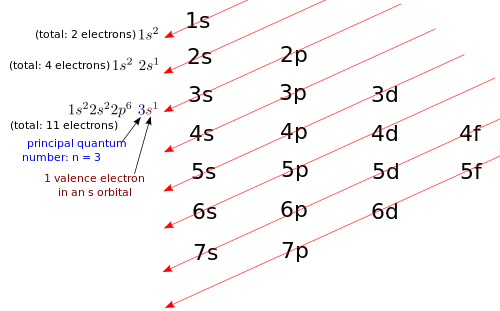
Therefore, nosotros write the electron configuration for Na: 1s two2due south two2p 6threes 1.
What is the highest primary quantum number that you see in sodium's electron configuration?
It'due south northward = 3, and then all electrons with north = 3 are valence electrons, and all electrons with n < iii are not-valence electrons. (Don't exist fooled by the 2p 6 orbitals. Fifty-fifty though they are p orbitals, non due south orbitals, they have northward = 2, and then they are not-valence electrons!) Sodium has 1 valence electron in an s orbital.
If y'all look at the last line in Case 1, Example ii, and Case iii y'all should notice a blueprint.
- Hydrogen has 1 valence electron in an due south orbital
- Lithium has ane valence electron in an s orbital
- Sodium has i valence electron in an due south orbital
In fact, all elements in the first column of the Periodic Table have one valence electron in an s orbital. Therefore, we would expect all of these elements to take similar chemical backdrop – and they do. (Hydrogen is special because it is the showtime element in the Periodic Table. Equally a event, hydrogen has only 1 proton and one electron, which give it special chemical properties. Sometimes scientists don't include hydrogen in the first column of the Periodic Table, merely instead requite information technology its own "special" column to reflect its special backdrop – we won't practise that hither, but you should realize that hydrogen does not have all the same chemic properties every bit the remainder of the elements in its column.)
The elements in the offset cavalcade of the Periodic Tabular array (other than hydrogen) are known as Group 1A metals, or alkali metals. When you compare the chemical properties of these elements (lithium, sodium, potassium, rubidium, cesium, and francium), what y'all'll notice is that they are all remarkably similar. Group 1A elements are metals, silver-colored, and soft. These elements are extremely reactive. Several of them explode if you lot put them in h2o.
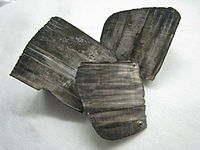
As pictured below, notice how the elements lithium (Li), sodium (Na), and potassium (K) all await alike. They are all soft, silver metals. Since Li, Na, and K are all Group 1A metals, they all share similar chemic properties.
Lithium (Li)

Sodium (Na)

Potassium (K)
And finally, considering they are so reactive, Group 1A elements are not found in their elemental grade in nature – in other words, y'all don't find pure sodium or pure potassium in nature.
Group 2A (IIA) Elements Take 2 s Electrons [edit | edit source]
All of the elements in the kickoff column of the periodic table have i valence electron in an south sublevel. How practice yous think the elements in the 2nd column of the periodic table differ? Permit'south find out by taking a expect at a few examples.
Example 4 – Beryllium
Write the electron configuration for beryllium (Exist).
Solution:
Kickoff, you notice beryllium on the Periodic Table. The Periodic Table tells you that the diminutive number for beryllium is Z = 4, thus glucinium has 4 protons. Neutral beryllium will also have 4 electrons. Y'all need to write the electron configuration for an atom with 4 electrons.
Every bit shown below, the diagonal rule applied to beryllium (Exist). Non-valence electrons: 1southward ii.
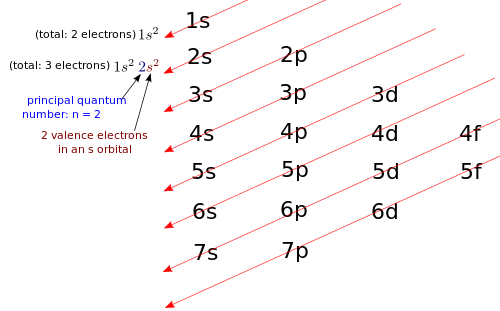
Therefore, nosotros write the electron configuration for Be: 1s 22s 2.
What is the highest principal quantum number that you see in glucinium's electron configuration?
It's north = 2, so all electrons with north = 2 are valence electrons, and all electrons with due north < 2 are not-valence electrons. Glucinium has ii valence electrons in an s orbital.
Example v – Magnesium
Write the electron configuration for magnesium (Mg).
Solution:
First, you lot discover magnesium on the Periodic Table. The Periodic Tabular array tells you that the atomic number for magnesium is Z = 12, thus magnesium has 12 protons. Neutral magnesium volition also have 12 electrons. Yous need to write the electron configuration for an atom with 12 electrons.
Therefore, the electron configuration for Mg: 1s 2twos 2twop 63s 2.
What is the highest principal quantum number that you see in magnesium'south electron configuration?
It'due south due north = three, then all electrons with n = 3 are valence electrons, and all electrons with n < three are not-valence electrons. Magnesium has 2 valence electrons in an s orbital.
Notice that:
- Beryllium has 2 valence electrons in an s orbital.
- Magnesium has two valence electrons in an south orbital.
You tin can probably guess the number and type of valence electrons in an atom of calcium (Ca), strontium (Sr), barium (Ba), or radium (Ra). If y'all guessed 2 electrons in an due south orbital, so you guessed right! All elements in the second column of the Periodic Table have 2 valence electrons in an due south orbital.
The elements in the second column of the Periodic Table are known every bit Group 2A metals, or alkali metal earth metals. As you might expect, because all Group 2A metals have 2 valence electrons in an south orbital, they all share similar chemic properties. Group 2A elements are metals, silver colored, and are quite reactive though they are not nearly equally reactive as the Group 1A elements.
Group 3A (IIIA) Elements Have south and 1p Electrons [edit | edit source]
All of the elements in the first column of the Periodic Table have 1 valence electron in an south sublevel and all of the elements in the second column of the Periodic Table have 2 valence electrons in an s sublevel. Can you lot make whatsoever prediction nearly the valence electrons in the 3rd column of the Periodic Table? Where is the third cavalcade of the Periodic Table? Information technology turns out that there are actually two different "third columns" in the Periodic Table. Take a close wait at the figure of the Period Tabular array (the first figure of this lesson). Tin you spot the column labeled "3A"? Can you spot the column labeled "3B"? Observe that the smallest atom in the "3B" cavalcade has Z = 21 (Scandium, Sc), while the smallest atom in the "3A" column has Z = 5 (Boron, B). (Yous demand to note that there is an alternating way to name 3A elements; they tin can too be referred to as group 13 since these elements are in the 13th column of the Periodic Table.) Therefore, it plain makes sense to discuss the 3A column first. Permit's figure out how many valence electrons atoms in the 3A column have.
Example half dozen – Boron
Write the electron configuration for boron (B).
Solution:
The Periodic Table tells y'all that the diminutive number for boron is Z = 5, thus boron has 5 protons. Neutral boron volition also have 5 electrons. You demand to write the electron configuration for an cantlet with five electrons.
Equally pictured below, the diagonal rule applied to boron (B). Non-valence electrons: anes 2.

Therefore, the electron configuration for B: 1s iiiidue south 22p 1.
What is the highest primary quantum number that you see in boron'southward electron configuration?
Information technology'south north = 2, then all electrons with n = two are valence electrons, and all electrons with n < 2 are not-valence electrons. Both the electron in the twop orbital and the electrons in the 2due south orbital are valence electrons. Boron has 2 valence electrons in an southward orbital, and 1 valence electron in a p orbital, for a total of iii valence electrons.
Example 7 – Aluminum
Write the electron configuration for aluminum (Al).
Solution:
The Periodic Table tells you that the atomic number for aluminum is Z = xiii; thus neutral aluminum has xiii protons and xiii electrons. You need to write the electron configuration for an atom with xiii electrons.
Therefore, the electron configuration for Al: 1due south 2twos 2twop vi3s 23p one.
What is the highest principal quantum number that you lot see in aluminum's electron configuration?
It'due south n = 3, so all electrons with n = iii are valence electrons, and all electrons with north < 3 are non-valence electrons. Both the electron in the 3p orbital and the electrons in the 3due south orbital are valence electrons. Aluminum has 2 valence electrons in an s orbital, and 1 valence electron in a p orbital, for a full of 3 valence electrons.
From Instance 6 and Example vii, we take:
- Boron has 2 valence electrons in an s orbital and 1 valence electron in a p orbital
- Aluminum has two valence electrons in an s orbital and ane valence electron in a p orbital
In fact, all elements in the 3A cavalcade of the Periodic Table have 2 valence electrons in an s orbital and 1 valence electron in a p orbital. That's a full of 3 valence electrons for atoms in the 3A column. Again, the chemical backdrop of 3A elements are like, because they have the same number and type of valence electrons.
Group 4A-8A Continue to Add together p Electrons to the Outermost Energy Level [edit | edit source]
By at present, you lot may have noticed a design relating the number of valence electrons to the column number. Group 1A elements have 1 valence electron. Group 2A elements have two valence electrons. Group 3A elements have 3 valence electrons. Grouping 4A elements have… well, we oasis't looked at them yet, simply what would you lot estimate? Information technology'due south pretty obvious. Group 4A elements have 4 valence electrons. Similarly, Group 5A elements take 5 valence electrons. In fact, the pattern continues all the way up to Group 8A elements, which have 8 valence electrons. Let'south have a expect at a few examples in order to figure out exactly what types of valence electrons are involved. First, we'll consider a Group 4A element.
Case 8 – Carbon
Write the electron configuration for carbon (C).
Solution:
The Periodic Tabular array tells you lot that the atomic number for carbon is Z = vi, thus neutral carbon has 6 protons and 6 electrons. You need to write the electron configuration for an cantlet with half dozen electrons.
Illustrated below, the diagonal dominion applied to carbon (C). Non-valence electrons: 1southward 2.
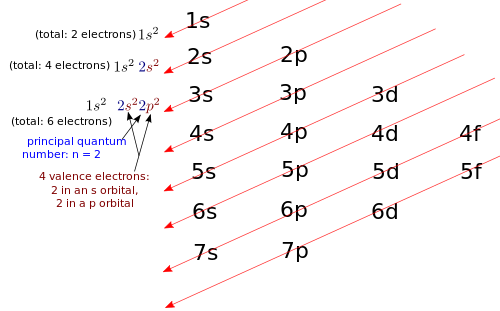
Therefore, the electron configuration for C: is 22s 2iip two.
What is the highest main quantum number that you meet in carbon'southward electron configuration?
It's northward = 2, so all electrons with n = 2 are valence electrons, and all electrons with due north < 2 are non-valence electrons. Both the electrons in the twop orbitals and the electrons in the 2due south orbital are valence electrons. Carbon has 2 valence electrons in an s orbital, and 2 valences electron in p orbitals, for a total of four valence electrons.
Now allow's consider a Group 5A chemical element.
Example 9 – Nitrogen
Write the electron configuration for nitrogen (N).
Solution:
The Periodic Table tells you lot that the atomic number for nitrogen is Z = 7, neutral nitrogen has 7 protons and 7 electrons. Y'all demand to write the electron configuration for an atom with 7 electrons.
Therefore, the electron configuration for N: 1s 2twos 2twop 3.
What is the highest primary breakthrough number that you come across in nitrogen's electron configuration?
It's northward = 2, so all electrons with n = 2 are valence electrons, and all electrons with n < 2 are non-valence electrons. Both the electrons in the iip orbitals and the electrons in the 2southward orbital are valence electrons. Nitrogen has 2 valence electrons in an s orbital, and 3 valence electrons in p orbitals for a total of 5 valence electrons.
As a final example, let's take a expect at a Group 6A element (or Group 16).
Example 10 – Oxygen
Write the electron configuration for oxygen (O).
Solution:
The Periodic Table tells you that the atomic number for oxygen is Z = eight; neutral oxygen has 8 protons and eight electrons. Yous need to write the electron configuration for an atom with eight electrons.
Therefore, the electron configuration for O: anes 2twodue south 2iip 4.
What is the highest principal quantum number that you lot see in oxygen's electron configuration?
Information technology's north = 2, and so all electrons with n = 2 are valence electrons, and all electrons with n < 2 are non-valence electrons. Both the electrons in the 2p orbitals and the electrons in the twos orbital are valence electrons. Oxygen has two valence electrons in an s orbital, and 4 valence electrons in p orbitals, for a total of 6 valence electrons.
So let'south summarize what we know so far:
- Group 1A elements have one valence electron in an s orbital
- Group 2A elements have 2 valence electrons in an s orbital
- Group 3A elements have ii valence electrons in an s orbital and i valence electron in a p orbital
- Group 4A elements accept 2 valence electrons in an s orbital and 2 valence electrons in p orbitals
- Group 5A elements have 2 valence electrons in an southward orbital and three valence electrons in p orbitals
- Grouping 6A elements have 2 valence electrons in an s orbital and four valence electrons in p orbitals
- Group 7A elements have ii valence electrons in an s orbital and 5 valence electrons in p orbitals
- Group 8A elements have 2 valence electrons in an s orbital and half dozen valence electrons in p orbitals
Notice that, after column 3A, each column one step farther to the right has ane additional valence p electron. Grouping 4A elements have ane more than valence p electron than Group 3A elements. Similarly, Group 5A elements have 1 more valence p electron than Group 4A elements. But what happens when you lot reach Group 8A elements? Why does the Periodic Table cease at column 8A? Let's think near that advisedly. Group 8A elements have half-dozen valence electrons in p orbitals. In the last chapter, you learned that the maximum number of p electrons at whatsoever energy level is half dozen. Therefore, there couldn't be a "9A" cavalcade, considering a "9A" column would have 7 p electrons in the valence energy level, which is impossible.
The fact that Group 8A elements take completely filled valence s sublevel and p sublevel is important in terms of their chemical properties. Group 8A elements are called noble gases. They are all gases, and they are not very reactive at all.
Lesson Summary [edit | edit source]
- All known elements are organized into the Periodic Table in such a way that elements in the same column have similar chemic backdrop.
- Just the highest energy electrons (valence electrons) are involved in chemical reactions. Therefore, it is merely these high-free energy electrons that are important in determining an elements chemic properties.
- Two different elements are likely to accept similar chemical backdrop when they take the same number of valence electrons.
- Elements with the same number of valence electrons are found in the same column of the Periodic Table.
- Elements with the same valence shell are found in the same row on the Periodic Table.
- All elements in the first column of the Periodic Table take 1 valence electron in an due south orbital. These elements are known as Group 1A metals or brine metals.
- All elements in the second column of the Periodic Tabular array have 2 valence electrons in an s orbital. These elements are known as Group 2A metals or alkaline earth metals.
- All elements in column 3A of the Periodic Table accept two valence electrons in an southward orbital and one valence electron in a p orbital.
- All elements in column 4A of the Periodic Table have 2 valence electrons in an s orbital and 2 valence electrons in p orbitals… etc.
- Column 8A has 2 valence electrons in an s orbital and 6 valence in p orbitals. Since any given energy level can accept at about half-dozen p electrons, column 8A elements accept a filled p sublevel. Therefore, they are inert (not-reactive), because they are unlikely to either gain or lose electrons. Group 8A elements are called noble gases.
Review Questions [edit | edit source]
- Take a look at the Periodic Tabular array. How would you lot draw it? Why do you think it has such a funny shape?
- Can you advise how elements in the aforementioned cavalcade of the Periodic Table might be similar?
- Choose the correct argument.
- (a) Mg has only 1 valence electron in an s orbital
- (b) F has only ane valence electron in an south orbital
- (c) O has simply 1 valence electron in an southward orbital
- (d) Kr has only i valence electron in an due south orbital
- Circle the appropriate element for each blank.
- (a) ____________ (Mg/N) has 2 valence electrons in an southward orbital, and 3 valence electrons in p orbitals.
- (b) ____________ (As/B) has 2 valence electrons in an s orbital, and 3 valence electrons in p orbitals
- (c) ____________ (Cl/P/Li) has 2 valence electrons in an southward orbital, and 5 valence electrons in p orbitals
- (d) ____________ (Al/Li/Na) has 1 valence electron in a p orbital
- Choose the correct statement.
- (a) Group 1A elements accept a full of 3 valence electrons
- (b) Group 5A elements take a total of 2 valence electrons
- (c) Grouping 7A elements have a total of 4 valence electrons
- (d) Group 8A elements have a total of 8 valence electrons
- (e) Group 2A elements have a total of five valence electrons
- (f) Grouping 1A elements accept a full of 3 valence electrons
- Fill in the blanks.
- (a) N has ___ valence electrons in an s orbital
- (b) N has ___ valence electrons in p orbitals
- (c) N has a total of ___ valence electrons
- (d) Ca has ___ valence electrons in s orbitals
- (e) Ca has ___ valence electrons in p orbitals
- (f) Ca has a total of ___ valence electrons
- Decide whether each of the post-obit statements is truthful or false.
- (a) K has 1 valence electron in an south orbital
- (b) Ge has 2 valence electrons in an s orbital
- (c) Se has 4 valence electrons in p orbitals
- (d) B has 3 valence electrons in p orbitals
- (due east) F has 2 valence electrons in an southward orbital, and 7 valence electrons in p orbitals
- (f) Ca has a total of 4 valence electrons
- Friction match the element to its valence electrons.
-
(a) Sr i. a total of 8 valence electrons (b) I ii. a total of 2 valence electrons (c) Ne 3. a total of 5 valence electrons (d) N iv. a total of 7 valence electrons
-
- Fill in the blanks.
- (a) Ba has __ valence electron(s) in an due south orbital, and __ valence electron(s) in p orbitals
- (b) Sn has __ valence electron(s) in an due south orbital, and __ valence electron(s) in p orbitals
- (c) Due south has __ valence electron(south) in an s orbital, and __ valence electron(s) in p orbitals
- (d) Po has __ valence electron(s) in an s orbital, and __ valence electron(s) in p orbitals
- (e) Na has __ valence electron(s) in an s orbital, and __ valence electron(due south) in p orbitals
- List all of the elements with exactly two valence electrons in p orbitals.
- An chemical element has two valence electrons in an s orbital and four valence electrons in p orbitals. If the chemical element is in the second row of the Periodic Table, which element is it?
- An element has 2 valence electrons in an s orbital and six valence electrons in p orbitals. If the element is in the aforementioned row as In, which chemical element is information technology?
Vocabulary [edit | edit source]
- alkali metals
- Group 1A metals. These are elements institute in the outset cavalcade of the Periodic Table, excluding hydrogen.
- alkaline earth metals
- Group 2A metals. These are elements plant in the second cavalcade of the Periodic Table.
- chemical backdrop
- The ways in which an element reacts with another element or compound.
- noble gases
- Group 8A elements. These are elements found in the eight column of the Periodic Table. They are inert, which means that they are very not-reactive.
- non-valence electrons
- All electrons in cantlet which are not valence electrons. Non-valence electrons are not of import in determining an element'due south chemic properties because they rarely get involved in chemical reactions.
- valence electrons
- The electrons in an atom with the highest value of n (the electrons in the highest free energy level).
This material was adapted from the original CK-12 book that can be found here. This work is licensed nether the Creative Eatables Attribution-Share Alike three.0 United states License

Which Elements Have Similar Properties,
Source: https://en.wikibooks.org/wiki/High_School_Chemistry/Electron_Configurations_of_Main_Group_Elements
Posted by: kleinprefor1940.blogspot.com
0 Response to "Which Elements Have Similar Properties"
Post a Comment